
Nosferatu (2024)
Some notes on rats.

“In one family they resorted to that horrible relic of superstition, the burning of the heart, etc., of the dead, and the ashes were swallowed by the survivors in the hopes that the fatal demon would be exorcised from the family, but it did not avail.”
Massachusetts State Board of Health, 1873.
The affliction came on suddenly, with a violent cough that turned bloody and the quick withering away of its victims, as if they were dying from the inside-out. It was tuberculosis, but the possibility of flesh eaters was on the minds of many grappling with the wake of death left by outbreaks of the illness in the 19th century United States, as it ate through entire families and decimated towns in months, like someone had irked the purveyor of some unknown and unseen curse. It’s true the witch trials (and its smallpox outbreaks) from 200 years earlier have a stronger hold on the popular memory of monsters in America, but the vampire panics of 1800s New England and the invisible wave of consumption that inspired them are quintessential history of this period, the kind that pushes the boundaries of thought by requiring an imagination necessary to comprehend why someone would dig up a body and rearrange its parts to prevent disease. The results of these fruitless hunts for the risen dead, for both the apocryphal and fairly well-documented incidents, were a gruesome manipulation of corpses. The panicked dug up bodies to sever skulls from their skeleton, pry open rib cages, consume ashes, and remove hearts while consumption continued its destructive course, despite their attempts at cosmic intervention.
There is an ‘old world’ quality to these stories, and it’s tempting to qualify or look away from this brutality as an exception of human behavior. Were we not yet finished with this kind of superstition by the 19th century? The dating of these events feels anachronistic and out of place, but we shouldn’t be so quick to dismiss the persistent power of occult belief. There is a lineage of esoteric belief in America with roots in its European colonial settlers, one that might disrupt our understanding of the time in some ways by dismissing the idea that 17th century colonial settlers emerged totally into a new frame of thought as they crossed the Atlantic, leaving behind a metaphysical world grounded in primitive and heretical Medieval thought in doing so. As noted by one of the chief authorities on New England vampire stories, folklorist Michael Bell, “God and witchcraft were not mutually exclusive.” It is complicated, but it appears that familial and colorful metaphysical beliefs and traditions for the inevitable times of uncertainty ahead accompanied settlers on their journeys, stowed just behind the Protestantism by which we characterize them. The emergence of vampires in New England two hundred years later is part of this continuum of fear that, despite leaps in scientific and social knowledge, would be familiar to the colonial period and sensibilities that preceded it, people who also saw things in the dark and sought a language to describe them. It’s also the same colonial period of history that produced The Witch, director Robert Eggers’ debut film about a family terrorized by the witch haunting their exile in the dark frontiers of their New England settlement. It was the beginning of an obvious and useful frame of reference for Eggers, the history of things we see in the dark, and a standing analog that has also inspired his latest work — an adaptation of F.W. Murnau’s silent expressionist vampire film Nosferatu. It’s a remake that, like other Eggers films, portends to a slippery kind of historical accuracy, one that relies on not just a strong sense of grounding in things as they happened, however that may have been, but an attempt to make-real the existence of vampires as to briefly gaze over the shoulders of history’s true believers. The results are, in many ways, mesmerizing.
Historically Accurate Vampirism
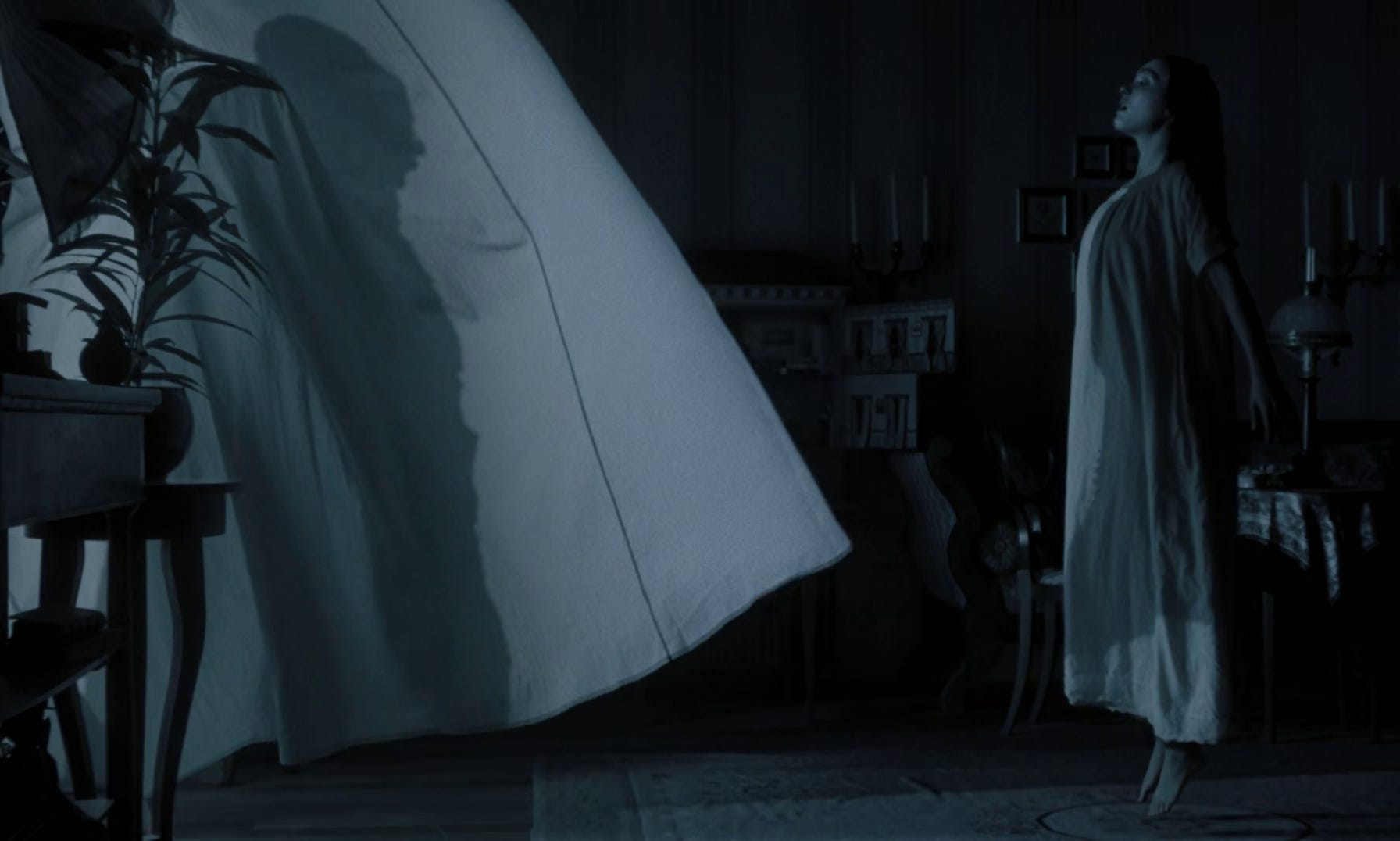
Ellen Hutter (Lily-Rose Depp) is a somnambulist terrorized by night visions, violent seizures, and bouts of sleepwalking. By her own account, these episodes began in her teenage years, in a moment of loneliness where Ellen sought the company of “a guardian angel, a spirit of comfort” through a prayerful plea to the infinite. She receives a psychic reply, our first encounter with the vampire Count Orlock (Bill Skarsgård) through a disembodied absent projection of his buzzing, guttural speaking voice in some indecipherable ancient language. After she is swept trembling into the reliving embrace of a shadowy figure, the voice proposes: “And shall you be one with me ever-eternally. Do you swear it?” When Ellen agrees, the maggoted corpse-like Orlock suddenly appears to firmly grasp her throat, then quickly vanishing from our view as we watch Ellen violently contort and seize outside in her garden.
The film’s opening scene represents an important shift in framing and something of a departure from tradition — the centering of Ellen as the narrative protagonist — a neither outlandish or a total alteration to Nosferatu’s historical or literary source materials. In the newest iteration of the Dracula/Nosferatu story, Ellen is still (perhaps more than ever) a symbolic venue, the connection between ancient magic and the 19th century, and the sacrificial object on which the film’s resolution quite literally balances. Nosferatu’s interpretation of these ideas involves a narrative slant, a shift toward Ellen that emphasizes the conflict between the so-called superstitions of pre-enlightenment thinking and the evolving medical gaze and forms of scientific inquiry that fail equally to treat and contain her afflictions. The intermixing of control, sexual desire, and violence are illustrated outright and often simultaneously, with Ellen at once struggling against Orlock’s psychic grasp while those tasked with her care drug and restrain her with doses of opium and hands wrapped tightly around her front-tying girdle, the one women who lacked in-home servants wore, her ailments and treatments equally nightmarish reflections of the 19th century.
How else do you make an historically accurate vampire? By exhuming a suspect and pinning his corpse to a grave, to start. It’s not the first shocking moment of Nosferatu (that would be the aforementioned cold open), but it’s a telling addition to the story, one that takes Thomas Hutter’s (Nicholas Hoult) familiar journey to finalize a spurious land deal between his employer and an ancient Transylvanian vampire called Count Orlock (Bill Skarsgård) and injects it with the folk histories of its cultural origins. The scene in which the villagers pin the accused to his resting place with an iron stake (a common method historically) is both a feverish embellishment from other adaptations and the beginning of a staccato sequence of encounters with the bloodsucking and hypnotic metaphysics of vampirism that deliberately blur the barrier between waking and sleeping states, between what is imagined and what is real.
The stylistic cogency is revealing, a perspective that finds success in demonstrating the frantic realizations inspired by a creature beyond death (this is equally attributable to editor Louise Ford, a role she’s held for all four Eggers films). Eggers’ commitment to the incorporation of historical flourishes presents this familiar encounter between Thomas and Orlock via a fidelity to the gaps in language and understanding that might characterize any long journey to meet a bloodsucking nobleman. The use of history, the gesture toward an accurate depiction of the supernatural through violent demonstrations from those who believe and experience, raises certain stakes, but not to shock for its own sake or an empty obsession over minutiae, history as told by its dressings and trimmings. Nosferatu is about a glimpse through past beliefs, the tools with which we make sense of our encounters with the unexplainable, and those who struggle to find a language for that which afflicts them.
Several Thousand Rats
If you’ve been following the unrelenting online press tour for Nosferatu, you likely already heard about the rats. The number has been reported between two and five thousand live rats used at various points over three months of filming, but it’s likely impossible to get a firm grasp on the figure (unless you happen to be the film’s hired “rat wrangler”). It makes for good promotional material — sensational in ways that implies a commitment to magnitude and verisimilitude in depictions of the horrific, including its sights and smells — but the rats have been largely swept up into the increasingly familiar contemporary form of relentless clips to spark online engagement. Skarsgård’s depiction of Count Orlock is a part of this, constantly forwarded as a significant element whose visual scale is deliberately hidden in promotional materials to suggest it must be experienced in filmic context to be properly understood. This is maybe true in a few ways for the rats as well, though I can’t help but assume they are destined to remain somewhere in the periphery of the film’s lasting impression, the supporting player to the movie’s better-known terrifying lead.
We seem to have mercifully passed this promotional cycle, but I’m still thinking about the rats, their contribution to not just the film’s atmosphere, but its narrative thrust and symbolic range. They’re an extremely obvious symbol brought up from the source material – rats appear as extension of Orlock and announce his presence in Wisborg, the original Count Orlock has exaggerated rat-like features, Dracula can control various animals — and while Nosferatu’s several thousand rats are an important visual language that represents plague-induced decay, their role as the bridge between supernatural and ordinary is a form of meaningful exaggeration for the exercising of a particular madness, an obsession with the question of historical depiction, the languages we use to try and describe things separated in time by great distances and large gaps, and the clarity this mad form of thinking offers us about our own world.
There is an obvious heavy laboring over the accuracy of Eggers’ portrayals and the presentation of his film’s subjects (something Eggers himself frequently states). It first presents as a familiar language — the objects characters hold, what they wear, the inflections of their voice appearing as small infusions of various period-appropriate context. This remains true of Nosferatu, a film that freely merges its historical and literary source materials through various obsessive gestures toward historical portrayal. The resulting visual image is exquisite and particular, a meticulously arranged period framework ready to be invaded by the otherworldly in a process of historical mind bending. It would be a mistake to take this attention to detail and particularity as the primary grounding of the film, however, rather than, like the plague rats, the exaggerated necrotic imagination of historical thinking, a kind of afflicted obsession with making-real the mythologies of human thinking. It’s an admirable trait in a filmmaker, the willingness to embrace the rotting corpse of history, and still Eggers’ greatest strength — a reminder that, though it may seem unnecessarily macabre or fetishistic, to fixate on the real gothic terrors of history is to truly embrace the dark complexity of belief.